


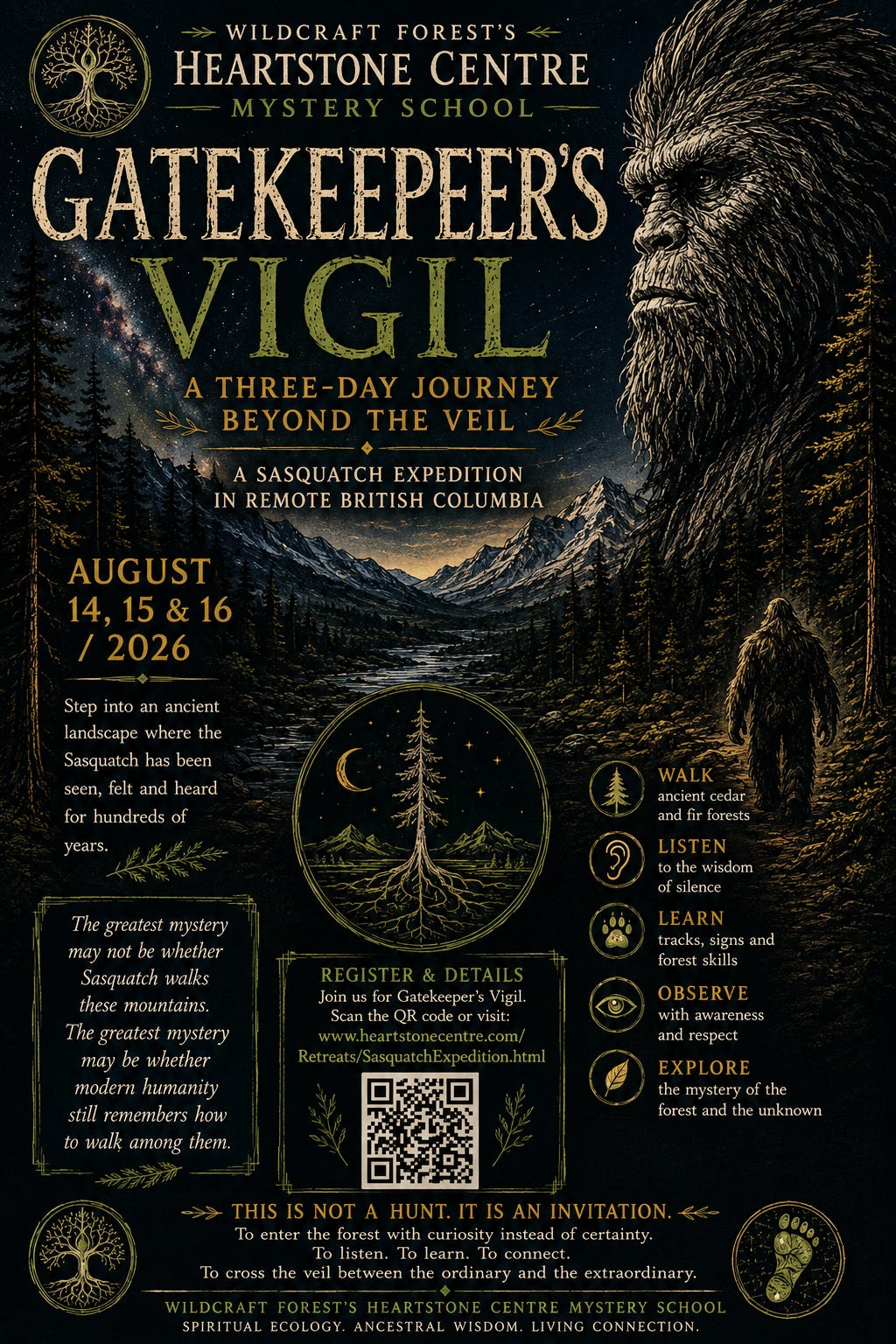
Before the first light touches the mountains on August 14, a small gathering of people will leave behind highways, schedules, and the familiar rhythms of modern life. They will travel into a remote valley of British Columbia where old forests still stand, where darkness arrives without the glow of cities, and where the night sky stretches from horizon to horizon with astonishing clarity. For three days they will walk quietly through ancient cedar and fir forests, share stories, study tracks and wildlife sign, listen to the silence between sounds, and lift their eyes toward the stars that have guided travelers across this landscape for thousands of years.
This is a place where the Sasquatch has been seen, heard, and felt for hundreds of years.
The event is called Gatekeeper’s Vigil: A Three-Day Journey Beyond the Veil. On the surface it is described as a Sasquatch expedition. Yet that description only hints at what participants are truly being invited to experience. This is not a competition to capture evidence. It is not an organized hunt for photographs or a quest to prove a legend. It is an exploration of one of humanity’s oldest questions: what happens when we enter a forest with curiosity instead of certainty? What changes within us when we walk into landscapes that still possess the power to surprise, humble, and transform?
At the Wildcraft Forest’s Heartstone Centre Mystery School, we have discovered that the most meaningful journeys often begin not with answers but with better questions. Does Sasquatch exist? That is certainly one question. But perhaps a more profound one is this: why have human beings, separated by oceans and languages, continued to tell remarkably similar stories about great forest beings for thousands of years? What has compelled generation after generation to look into the deep woods and feel that the natural world contains intelligences and relationships that civilization has not fully understood?
Those questions form the heart of Gatekeeper’s Vigil.
One of the most fascinating discoveries in preparing this expedition is that the search extends far beyond footprints or eyewitness reports. It invites us to investigate a much larger relationship between wilderness, perception, and consciousness. Geography plays a role. So does astronomy. Together they form the backdrop to a mystery that refuses to disappear.
Imagine drawing a broad band around the Earth between approximately forty-five and fifty-five degrees north latitude. This ribbon of land circles the globe through the temperate rainforests of British Columbia, the Rocky Mountains, the Great Lakes, Scandinavia, the Black Forest of Germany, the Carpathian Mountains, Siberia, Lake Baikal, the Altai Mountains, Sakhalin Island, and northern Japan. It is one of the greatest forest corridors on Earth, containing old-growth ecosystems, mountain ranges, river valleys, and wildlife migrations that have shaped human cultures since the last Ice Age.
The forests still stand across the Latitude of Giants. The constellations still turn above them. And the stories — of watchers, guardians, and wild beings — continue to move through human culture like shadows between trees. Read this whole story:

Across this northern belt we encounter the Sasq’ets of the Pacific Northwest, the Woodwose of medieval Europe, the Leshy of Slavic forests, the Almas of Central Asia, mountain beings of northern Japan, and countless other traditions describing large, elusive forest people who seem to exist just beyond ordinary human experience. The names differ. The cultures differ. Yet the stories echo one another with surprising consistency. Intelligent beings. Brief encounters. Great strength. An uncanny ability to appear and disappear. A profound connection with ancient forests.
For generations, investigators have searched for physical evidence that might explain these accounts. Tracks have been cast. Hair samples have been collected. Eyewitnesses have been interviewed. These efforts remain valuable and continue to contribute to the ongoing discussion. Yet they may represent only one side of the investigation.
Another question has quietly emerged.
What if the greatest mystery surrounding Sasquatch is not simply where it lives, but how it is perceived?
Again and again, witnesses describe encounters that challenge ordinary expectations. A figure crosses an opening and vanishes behind a single tree. Massive footprints end abruptly. An overwhelming sense of presence is experienced even when nothing can be seen. Entire forests seem to fall into an unnatural silence moments before an encounter. While each account deserves careful scrutiny, the remarkable consistency of these descriptions invites us to investigate another possibility—not as established fact, but as a line of inquiry that deserves thoughtful exploration.
Could Sasquatch possess sensory abilities that modern humans have largely forgotten or perhaps never developed?
Nature already provides astonishing examples. Sharks detect faint electrical impulses produced by living organisms. Migratory birds orient themselves using the Earth’s magnetic field. Certain insects perceive electrical charges surrounding flowers. Cats use their whiskers to detect subtle movements in the air long before they become visible.
These are not extraordinary claims. They are established examples of life evolving specialized ways of sensing the world.
Now imagine a large forest-dwelling primate that has evolved within old-growth ecosystems over thousands of generations.
Its long body hair may be more than protection against cold and rain. It may function as an extraordinarily sensitive sensory array. Every strand responding to minute changes in air movement, humidity, electrical conditions, magnetic fluctuations, and environmental vibration. Collectively, this living network could provide an awareness of the forest that is almost unimaginable to people whose senses have become dominated by artificial environments.
This possibility opens an even deeper investigation.
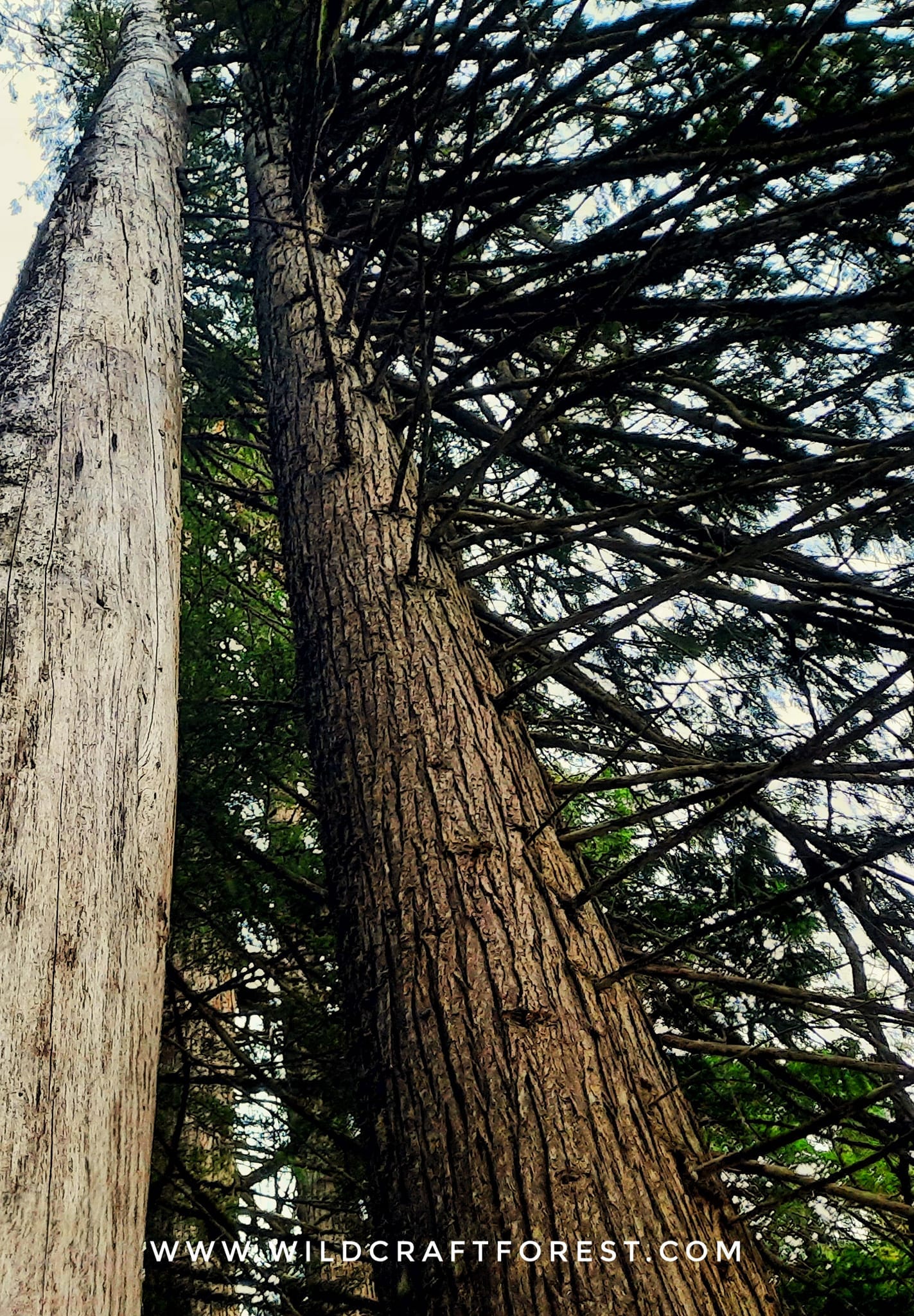
Ancient forests are not merely collections of trees. They are interconnected living systems. Towering cedars, Douglas-firs, hemlocks, underground fungal networks, flowing groundwater, exposed bedrock, mountain ridges, and atmospheric conditions interact continuously. Indigenous cultures around the world have long recognized that certain places possess a distinctive presence. They are often described as sacred sites, places of power, or locations where the boundary between the ordinary and the extraordinary feels unusually thin.
Modern ecology increasingly reveals just how interconnected forests truly are. Trees communicate chemically through shared fungal networks. Root systems exchange nutrients. Electrical signals travel through living tissues. Entire ecosystems behave less like isolated organisms and more like integrated communities.
Could there be additional forms of environmental communication that science has not yet fully understood?
This question becomes particularly intriguing when considered alongside countless Sasquatch reports describing sudden appearances and disappearances.
Perhaps the phenomenon is less about vanishing than about perception.
Perhaps there are moments when the observer and the observed are no longer occupying precisely the same relationship with their surroundings.
Participants in Gatekeeper’s Vigil will not be taught that Sasquatch travels through dimensional portals. Such statements move beyond available evidence. Instead, we will investigate a different possibility—that ancient forests themselves may influence human perception in ways we are only beginning to appreciate.
Silence changes awareness.
Darkness changes awareness.
Firelight changes awareness.
The night sky changes awareness.
Hours spent moving quietly through old-growth forests change awareness.
Anyone who has spent extended time in wilderness recognizes this transformation. The forest gradually becomes more alive. Sounds separate into distinct voices. Subtle movements become noticeable. The mind slows. Attention deepens. It is not that the forest changes. It is that we begin to perceive more of what has always been present.
Within the Mystery School we sometimes describe this transition as moving beyond the veil.
The veil is not necessarily another world.
It may simply be the boundary created by distraction, noise, speed, and certainty.
Crossing that boundary requires patience rather than technology.
Listening rather than searching.
Presence rather than pursuit.
Perhaps this explains why so many Indigenous traditions describe great forest beings not as monsters but as neighbours, guardians, or elder relatives. Their role is not to frighten humanity but to remind us that we are participants within a living world rather than its owners.
Whether Sasquatch ultimately proves to be an undiscovered species, a phenomenon of human perception, or something that refuses easy classification, the enduring value of the story remains unchanged. It continues to call people back into ancient forests. It encourages humility in places where certainty quickly dissolves. It reminds us that the natural world still contains mysteries worthy of careful observation rather than immediate dismissal.
That is the true purpose of Gatekeeper’s Vigil.
We are not travelling into the mountains to conquer a mystery.
We are travelling into the mountains to become worthy of encountering one.
If, during those three days, participants discover fresh tracks, hear unexplained vocalizations, or experience moments they cannot easily explain, those experiences will become part of the ongoing investigation. If they discover only deeper silence, greater awareness, and a renewed relationship with the living forest, the journey will have been no less successful.
Perhaps the greatest evidence for Sasquatch has never been a footprint.
Perhaps it is the enduring human instinct to walk into an old forest with an open mind, to stand beneath ancient trees, to look into the darkness beyond the firelight, and to sense that the world is still far more alive, more mysterious, and more interconnected than we have yet imagined.
The possibility remains a real one. If the Sasquatch comes to understand that we seek to pull back the veil in peace – will they make themselves known to us?
Time will tell – and for this event, don’t cut your hair.
If you would like to explore with us, this Sasquatch Expedition its being offered from our Mystery School at the Heartstone Centre here’s the link:
http://www.heartstonecentre.com/Retreats/SasquatchExpedition.html